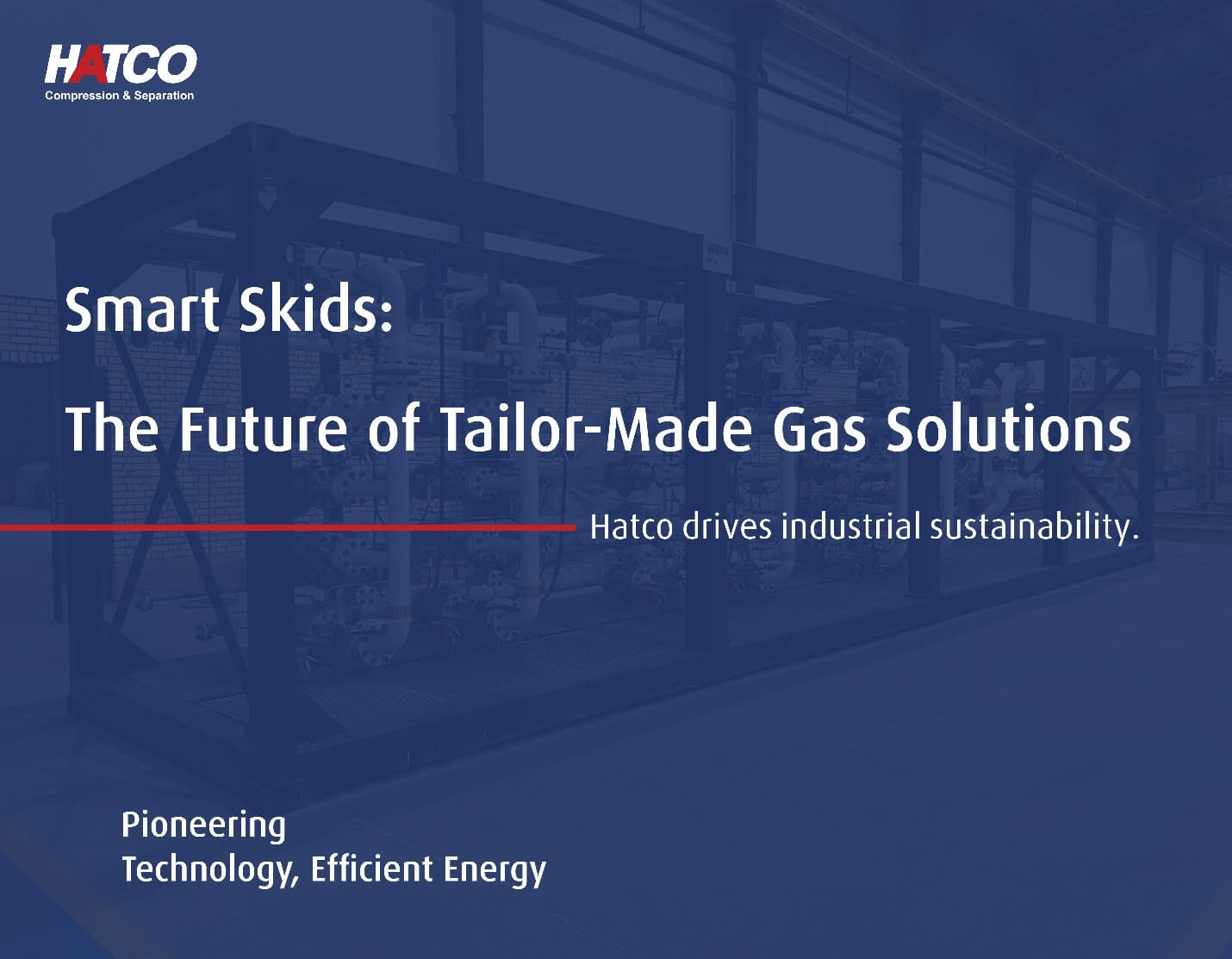
Smart Skid Packages: The Future of Tailor-Made Gas Solutions
How Smart, Compact, and Modular Skid Packages Are Transforming Process Design and Installation in Industrial Facilities
In today’s fast-paced industrial landscape, efficiency, flexibility, and speed are crucial for success. Industries such as oil and gas, petrochemicals, and steel making require quicker project turnarounds and lower capital and operational expenditures (CAPEX/OPEX). As a result, traditional-built process systems are increasingly being replaced by smart skid packages-compact, self-contained, and pre-engineered modules that provide a more effective approach to plant design and industrial gases processing.
In industrial terminology, a “skid” refers to a unitized frame or base that supports various components, including piping, valves, instruments, vessels, heat exchangers, and rotary equipment (such as compressors), all assembled as a single system. Smart skids take this concept further by incorporating automation, data intelligence, and diagnostics, transforming them from passive equipment into intelligent process units.
This article explores how smart skids are redefining the engineering, procurement, and construction (EPC) phases of gas systems, demonstrating why they represent the future of industrial gases solutions.
1. The Rise of Skid-Based Engineering
1.1 What Are Skid Packages?
Skid packages are modular units that are pre-assembled and tested by the manufacturer, making them ready for installation at the customer’s site. These systems provide a plug-and-play solution, significantly reducing on-site labor and installation time.
Skid packages can serve various functions, including compression process, purification, metering, pressure reduction, and cryogenic separation. Advanced skid packages, often referred to as smart skids, further enhance these functionalities by incorporating sensors, PLCs/SCADA control systems, and remote monitoring capabilities. This integration allows for real-time visibility and control over operations.
1.2 Benefits over Traditional Systems
Older ones process installations often involve lengthy engineering and site-specific fabrication, allowing for a high margin of errors. In contrast, skid-mounted systems offer several advantages:
• Standardized yet customizable.
• Pre-tested in a controlled environment.
• Easier to transport and install.
• More compact and space-saving.
• Enhance safety by reducing the number of field welds and minimizing manual work on-site.
2. Smart Skid Packages: Modularity Intelligence
This solution encompasses more than just modular design. By integrating Industry 4.0 technologies, these systems act as proactive agents to enhance plant performance.
2.1 IoT and Automation
The integration of Industrial Internet of Things (IIoT) devices allows these systems to self-monitor and communicate with control networks across the plant. Key features include:
• Sensor-based monitoring
• Predictive maintenance analytics
• Remote diagnostics
• Automated safety shutdowns
• Cloud-based data logging
This transition from reactive to predictive operations reduces unplanned downtimes and prolongs equipment life. This transition from reactive to predictive operations reduces unplanned downtimes and prolongs the equipment lifecycle.
2.2 Machine Learning and Process Optimization
Some intelligent skid packages utilize machine learning algorithms to analyze operational data and optimize process parameters. For instance, a gas dehydration unit can automatically adjust flow rates or chemical dosing based on ambient humidity, gas composition, or load variations.
2.3 Cybersecurity and Remote Access
With remote connectivity comes the need for strong cybersecurity measures. Modern smart skids include firewall-protected gateways, encrypted communications, and user access control systems, ensuring that remote operation is both feasible and secure.
3. Skid packages solution in Gas Processing: Use Cases and Applications
Smart skids are essential in many of the gas production industries, where many important factors such as pressure, temperature, purity, and safety are crucial.
3.1 Air Separation Units (Cryogenic Technology)
In cryogenic air separation plants, this solution can be utilized for the following purposes:
• Pre-cooling and purification (molecular sieve beds)
• Control of cryogenic distillation columns
• Pumping of liquid oxygen, nitrogen, and argon
• Final product metering and vaporization
These systems are designed with a skid-based approach, which shortens construction time while providing effective thermal insulation and precise process control. These systems are designed with a skid-based approach, which shortens construction time while providing effective thermal insulation and precise process control.
3.2 Natural Gas Treatment and Compression
Skid packages could be a perfect solution for remote or offshore locations. Some examples include:
- Dehydration skids (e.g., TEG units)
- Amine gas treating units
- Fuel gas conditioning systems
- Compressors (including coolers and separators)
Remote areas particularly benefit from smart skids equipped with telemetry capabilities, which enable unmanned operation and centralized control.
3.3 Hydrogen and Green Energy Applications
In hydrogen gas production, especially via electrolysis or SMR (Steam Methane Reforming), smart skids are used to:
- Condition feedstock
- Compress and purify hydrogen
- Handle high-pressure storage and fueling
The modular nature supports scalability, which is essential as hydrogen infrastructure expands.
4. From Design to Deployment: The Lifecycle of a Smart Skid
4.1 Front-End Engineering (FEED)
A well-designed smart skid starts with the highest definition of the process, client requirements, and operating environment. FEED includes:
- Process simulation
- Layout and 3D modelling
- Instrumentation selection
- Safety studies (e.g., HAZOP)
The use of digital twins-virtual models via this solution enables early troubleshooting and validations.
4.2 Fabrication and FAT (Factory Acceptance Testing)
Skid modules are assembled in-house, allowing for strict quality control. Smart skids undergo:
- Full electrical and instrumentation integration
- Simulation of process conditions
- FAT procedures, including PLC logic and safety interlocks
This reduces on-site commissioning from weeks to mere days.
4.3 Installation and Commissioning
Due to their plug-and-play design, smart skids require only:
- Anchoring on prepared foundations
- Utility hook-ups and interfaces
- DCS connections
Commissioning teams can often work remotely, guiding operators through start-up procedures via HMI or web dashboards.
4.4 Operation and Maintenance
A core strength of smart skids lies in their maintainability:
- Scheduling and essential services based on conditions and alarms
- Process trends aid in root-cause analysis
- Digital manuals are available
Some OEMs offer remote support services or digital maintenance twins to further reduce downtime.
5. Challenges and Considerations
Although the advantages of smart skid packages are significant, there are also some challenges to consider.
5.1 Integration with Legacy Systems
In brownfield projects (repurposing or enlarging preexisting structures or infrastructure), integrating modern smart skids with outdated DCS or SCADA systems can lead to compatibility challenges. Protocol converters, such as Modbus to OPC-UA, or edge devices, are frequently required.
5.2 Higher Upfront Costs
Smart skid packages may require a higher initial investment because of their advanced automation features. However, the savings in lifecycle costs from reduced downtime and faster installation often justify this premium.
5.3 Engineering Complexity
Creating a compact, maintainable layout for hazardous fluids (based on mechanical properties and/or reactivity) requires extensive experience and simulation.
6. The Future of Smart Skid Packages
The future of gas processing is modular, intelligent, and scalable. Some anticipated trends include:
- AI-powered control systems that continuously optimize each process performance
- Self-healing networks for uninterrupted operation
- Blockchain-backed asset tracking for spares and maintenance records
- Augmented Reality (AR) overlays for virtual troubleshooting and operator training
- Sustainable designs using lower-carbon materials and energy-efficient components
As decarbonization and green energy progress, smart skids will play a crucial role in hydrogen hubs, carbon capture systems, and decentralized power-to-gas solutions.
Conclusion
Smart skids represent a significant change in how industrial facilities approach gas processing. By integrating the advantages of modular design with modern automation technologies, these systems provide exceptional efficiency, reliability, and operational insights.
With benefits such as faster project execution and real-time, data-driven decision-making, smart skids are more than just a trend; they lay the groundwork for the next generation of industrial infrastructure. As the demand for flexible and intelligent processing units increases, both engineering firms and end-users must adapt to this evolution. The future is not only built; it is pre-constructed, interconnected, and intelligent.
User Comments