
Centrifugal Compressor: The Heart of Industrial Gas Compression Systems
Precision, Power, and Performance in Motion
Gas compression is critical in every modern industrial gas, chemical, and energy process.
Among all compressor technologies, the centrifugal compressor stands out for its efficiency, continuous operation, and high-capacity performance.
At Hatco, we design and supply tailor-made centrifugal compressors for instrument air/plant air & process air systems, air separation units (ASU), cryogenic systems, and process gas applications — where precision and reliability define success.
What Is a Centrifugal Compressor?
A centrifugal compressor is a dynamic machine that increases gas pressure by converting kinetic energy into potential (pressure) energy using a high-speed rotating impeller.
Basic Working Principle:
- Gas Inlet: Gas enters axially at the compressor eye.
- Acceleration: The impeller blades accelerate gas outward at high velocity.
- Diffusion: The diffuser slows the gas, converting velocity into pressure.
- Discharge: The pressurised gas exits through a volute or return channel.
This process enables continuous, oil-free, vibration-free compression — ideal for sensitive industrial and cryogenic processes.
Core Components of a Centrifugal Compressor
| Component | Description |
| Impeller | Rotating wheel that imparts velocity to gas. |
| Diffuser | Converts kinetic energy into pressure. |
| Volute Casing | Collects and directs compressed gas. |
| Bearings & Seals | Support the rotor and prevent leakage. |
| Gearbox & Shaft | Transmit mechanical power. |
| Intercoolers | Reduce gas temperature between stages. |
| Lubrication System | Ensures smooth operation and reliability. |
How Does a Centrifugal Compressor Work?
Centrifugal compressors operate in multiple stages, each incrementally increasing pressure.
Process Overview:
- Intake and Compression – Gas enters the impeller and gains velocity.
- Diffusion – Velocity is transformed into pressure.
- Cooling (Intercooling) – Heat from compression is removed between stages.
- Discharge – Compressed gas is sent to the process or cryogenic unit.
By controlling impeller speed, inlet guide vanes, and cooling flow, Hatco engineers optimise each unit for energy efficiency and stable flow control.
Types of Centrifugal Compressors
1. Single-Stage Centrifugal Compressors
- Perfect fit at low pressure ratio in air & gas applications.
- Compact and simple design.
- Ideal for small to very high volumes at low-pressure demand.
2. Multi-Stage Centrifugal Compressors
- Common in air, process gas and cryogenic plants.
- Each stage adds pressure, achieving very high overall compression ratios.
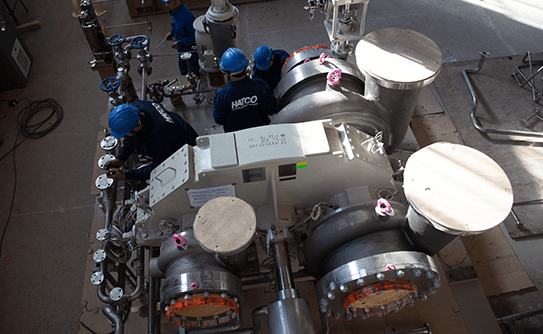
3. Integrally Geared Centrifugal Compressors
- Features a central bull gear driving multiple impellers.
- Compact and efficient — excellent for instrument and plant air, air separation and nitrogen generation.
Industrial Applications
Centrifugal compressors are used across many industries for air and gas compression:
| Industry | Application |
| Steel & Metallurgy | Oxygen and nitrogen compression for furnaces. |
| Petrochemical | Process gas |
| Oil & Gas | Process gas, pipeline, gathering, gas injection, etc. |
| Utility | Instrument Air & Plant Air |
| Cryogenics | Air compression in ASUs and LNG. |
| Energy & Power | Gas turbine inlet air supply. |
| Electronics | Ultra-clean nitrogen delivery. |
| Food & Beverage | Nitrogen packaging and carbonation. |
Advantages of Centrifugal Compressors
- Continuous, Pulsation-Free Flow
- Oil-Free Compression for Clean Processes
- High Efficiency at Constant Load
- Compact and Reliable Design
- Lower Maintenance Costs
- Long Operational Life
These characteristics make centrifugal compressors the ideal choice for Hatco’s ASU and cryogenic applications.
Centrifugal Compressors in Air Separation and Cryogenic Systems
Cryogenic Air Separation Units (ASUs) rely on centrifugal compressors for:
- Supplying high-pressure air to the cold box
- Ensuring stable flow and purity of oxygen/nitrogen
- Enabling energy-efficient operation
Hatco’s compressors are optimised to work seamlessly with:
- Pre-purification units (PPU)
- Heat exchangers
- Cryogenic columns
Maintenance and Reliability Engineering
Best Practices for Maximising Compressor Life:
- Routine Vibration Analysis
- Bearing and Seal Inspection
- Oil and Filter Management
- Performance Curve Monitoring
- Digital Predictive Maintenance
Hatco offers maintenance contracts, field inspections, and spare part management to ensure peak reliability for every installed compressor.
Energy Efficiency and Digital Control
Modern Hatco compressors integrate Variable Inlet Guide Vanes (IGVs) and PLC-based control systems to dynamically adjust flow and minimise power consumption.
Energy Optimisation Techniques:
- Real-time performance monitoring
- Heat recovery from intercoolers
- Predictive maintenance with SCADA data
- Integration with plant-wide DCS systems
Hatco Engineering and Manufacturing Standards
Every Hatco centrifugal compressor is designed under strict API 617, API 672 and ISO 10439 standards, ensuring reliability, efficiency, and safety.
Key Design Features:
- Robust impellers with the best material choice
- Precision-balanced rotors
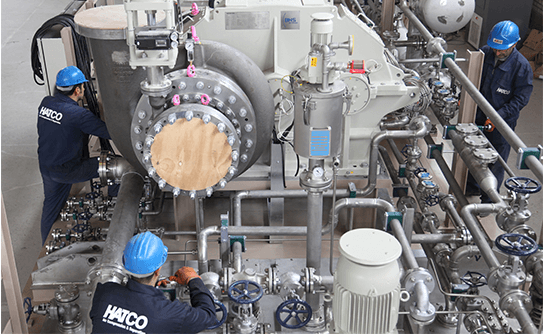
- Modular skid-mounted assemblies
- Noise and vibration reduction
- Full system automation capability
Each compressor is factory-tested under simulated load conditions for guaranteed performance.
Future of Centrifugal Compression Technology
As industries move toward hydrogen energy, carbon capture, and digital process optimisation, centrifugal compressors are evolving with:
- Magnetic bearing systems (oil-free operation)
- Integrated variable-speed drives (VSDs)
- Predictive digital twins
- Hybrid cryogenic-compression systems
Hatco continues to innovate compressor design for next-generation clean energy and sustainable production.
Conclusion
The centrifugal compressor is the backbone of modern gas compression — offering unmatched performance, reliability, and purity.
At Hatco, we combine cutting-edge engineering with decades of experience to deliver energy-efficient compressor systems for cryogenic, process, and industrial applications.
When you partner with Hatco, you invest in:
- Engineering precision
- Sustainable performance
- Global reliability and service excellence
Frequently Asked Questions
Steel, petrochemical, and gas production industries rely on them for large-scale, continuous gas compression.
Yes, especially at constant load — they achieve higher isothermal efficiency than screw or reciprocating compressors.
With proper maintenance, 20–25 years of service life is common.
Absolutely — Hatco engineers design air, nitrogen, hydrogen, CO₂, and more compressors.


User Comments